Showing posts with label the earth. Show all posts

Sol Invictus

5 comments

Thursday, 4 September 2014


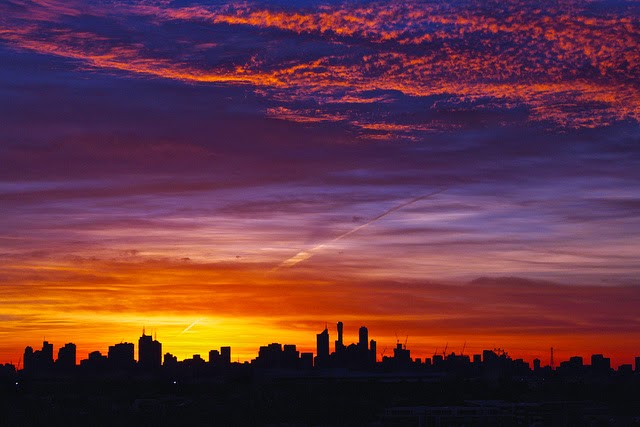
Melbourne sunrise.  Pic by Steve Davidson

When you consider the financial and environmental benefits, it’s unsurprising rooftop solar power has taken off around the world. Solar is sexy. It's also the grand narrative pantomime for our age, with Tony Abbott our local panto villain – his government is not behind you, nor behind the earth, for that matter. They’re behind the friends and supporters with links to fossil fuels who donated more than A$900,000 to the Libs in four years.

It’s unsurprising that the old guard, who stand to lose most from change, dig their heels in so. We are creatures who do not take kindly to change at the best of times. Our physiology is yet to catch up with our technology and our global connectedness, and our anxiety levels reflect that, as do our biases. Add megabucks in, and you can understand why their sight is so short and their ways so corrupted, though it may be hard to forgive them their blind stupidity.

The change that is to come must come from us, from the so-called leaners. As ever it’s always been.

Someone once said that cash is deceptive. It’s never quite enough to satisfy the particular discomfort that comes from living in this world where nothing is as safe as we wish it to be. Though it is hard to imagine, even Gina Rinehardt – who earned in 3.9 minutes today what I earned in the entire 2013 financial year – feels fragile living here too. Can you imagine living with such a level of hatred directed towards you? Of course you’d surround yourself, more and more, with gatedness, with the people of yes. And even if you’ve had money and power all your life, surely it doesn’t stop the 3am shadows nipping out from the dark whispering that despite it all, you still don’t feel safe. And if Gina and those like her are taking any notice of the still point our society is heading towards, they might just be feeling the nip of the pitchforks at their heels, too.

When your fortune is built on coal – or, for that matter, on newspapers, or on keeping a political party in office – the fear and addiction that comes with that power and success are the noise that drown out the signal that everything, and everybody, ends. (All good Buddhists, Taoists, and people who have watched Six Feet Under know this). The pendulum always swings. The world, Nassim Nicholas Taleb would suggest in his book Antifragile, becomes more fragile when we try and keep it from swinging, not less. Some of the mess we find ourselves in is because we simply don’t know when to stop meddling. We feel so unsafe, so we try to control what is required of us to let be. Sometimes, it is better to sit back, take a breath, and do nothing. Inaction is its own form of action.

Once, the stories we told ourselves about ourselves were limited and local and the ways we kept ourselves warm were the same. Forest wood and coal fared fine when used for household energy purposes. It wasn’t until the Industrial Revolution and the mass rise of industry that the extraction of coal got deeper and dirtier and required more than a bunch of people digging it out with picks.

Today, urbanisation and globalisation have stripped many of our old stories away, just like Mr Abbott’s counterparts in the Tasmanian government plan to strip away more of Tassie’s old-growth forests. The stories we tell ourselves to keep warm now are just as inclined to come from a culture from the other side of the world as from any remnants we are lucky to glean from our own, and if we do have a shared global story today it’s about unforseen climate shit hitting the fan along with long foreseen inequality. See the smog blocking out Beijing’s cityline? Gina dug that out of a hole from land her forebears didn’t even know existed 200 years before.

The problem with all the stuff that needs changing is that we see now like we’ve never seen before the impacts of our unintended actions. At the same time, this expanded view is delivered to us through increasingly fragmented shards of information. Our world’s health report is delivered to us as a whole glass globe made entirely of shards. This continual central nervous system rev-up makes it hard for us to distinguish the signal from the noise and know when to stop looking and start breathing.

Because we have so much to do, right? The way we do stuff is so wrong in so many ways. Ever thought about why, if you want to make big bucks, you can’t do it feeding the homeless? Or that money, invented out of thin air by our richest, is sold to us as a debt, and yet it’s so damn hard to come by? Or how for decades the IMF and the Wold Bank have bailed out the poorest in the world by selling them loans they could never afford to pay back? Or of how we already produce enough food to feed the world; it’s our systems of distribution that are the problem?

All that stuff is dirty, complicated mess, and combine it with all of that win/lose/leaner crap spoken from entitlement, it’s exhausting. We want to get away. We need to pan out a bit and get some distance and some silence. It’s been just over 40 years since our first photographic glimpse beamed back to us of a vision of the earth as a whole, in colour, from space. A beautiful blue, green and brown ball, swirly with clouds, grandly hanging, dammit, right in the middle of the air.
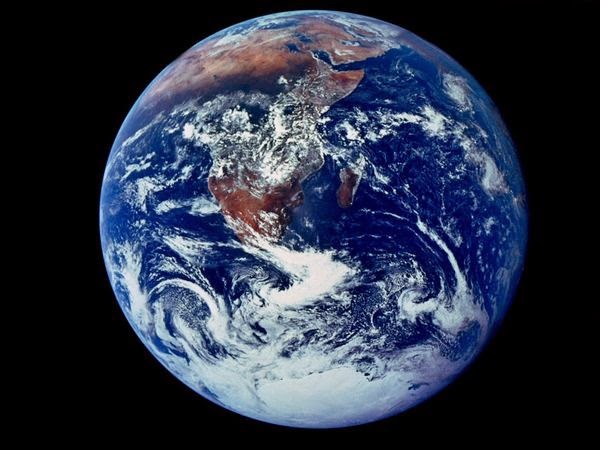
Pan up and out to that 1972 view and from here you see the potential for cohesion. It’s silent up here. Silence might be terrifying to us, in our noisy world, but there is strength in it and a peace once you get used to the agarophobia. Out here, we can believe that change is possible. And of course it is – it’s happening all over the place, if we can just distinguish the signals from the noise.

Out here in space, we can turn and see the sun ... actually, probably best not to frazzle your eyeballs off, so let's keep it metaphorical.  Up here, that damn sun couldn’t be more egalitarian if it was wearing a beret, chowing down on a croissant, and welcoming in the eight hour day. What is more egalitarian than the sun? Though Tony Abbott and his rich friends worldwide seem to believe it shines out of themselves, the fact is that the sun shines on the egalitarian and the oligarch alike. And while solar power is not going to solve everything, it’s a damn good and hopeful symbol of what's started.

If we are all made of stars, then what better way to fuel our lives than star energy? It’s 99% pollution free.

Hills Ambivalence

4 comments

Monday, 3 February 2014

I remember when I first started seeing my partner.  He lived in Belgrave in the Dandenong Ranges on the outskirts of Melbourne (still does - and now I do too), and when I came to visit I'd get enraptured about the animal life in abundance out the door.   I still do - the kookaburras, the rosellas, the king parrots (especially the king parrots.  The combination of their beautiful silky eye and the sweet sounds that come from their throats won me over immediately).

And I fell in love with the cockatoos.  Such enormous things.  So smart.  You could see them sussing you out and thinking about stuff.


I fell in love with a cockatoo who I worked with for a day.  Our boss was away and so my co-worker brought in his pet to work.  Now, if I was at school with Mary and she'd brought her lamb, I'd be the kid vomiting from overexcitement, laughing and playing like a mad thing, to see a lamb at school.  It just breaks up the monotony, right?   An adult bringing in their cockatoo to work while the boss was away was altogether too delightful for even my shite memory to forget.  I commandeered Ollie for as much time as I possibly could that day.  I sat, working on a typesetting machine that seems now like it's something out of the 1890's even though it was 1987, while Ollie nibbled occasionally upon my ear.

It was a good day.

And so because cockatoos are so cool, I was a little curious about why my partner was so antagonistic towards them.  What's there to hate, right?

Well, this, for example, done entirely at the hand - or beak, rather - of those gorgeous cockies.


I think cockatoos chew up stuff for pleasure, along with other practical reasons like beak-sharpening and cleaning purposes.

Wouldn't it be nice if cockatoos could be trained to mess only with wood that's not attached to your house.  Like the masses of trees surrounding it, for instance.  If I could become the cockatoo whisperer, I'd be in great demand amongst Australian house owners.  Or if I could build a beaking post that cockatoos were insanely attracted to, that was painted in an environmentally friendly cockatoolian version of catnip, I'm pretty sure there'd be a market for that, too.

Nature is amazing in its resourcefulness and reuse and upcycling.  Animals (including people, before Bunnings existed) use what's there in creative ways.  And that's why one bird's pleasurable destruction has become (at least temporarily) another mammal's home.  Take a squiz, a little closer.


See that greyish-lookin' thing?  That's a bit of a possum. 

Perhaps there aren't enough hollowed-out bits of logs to go around, and the last possum in for the night is stuck with the crappy digs, like a shitty, cheap motel with poo stains on the carpet.  This is not the biggest of spaces - I've felt inside.  That possum sleeping in there would be squashed.  And it was hot last night.  It sure can't be all that comfortable rammed in there with fur on top.

Turn off the Lights

8 comments

Friday, 29 November 2013

Pic by Benjamin Benschneider/Maxine Nagel and The Seattle Times.
One of the pictures above, of the Seattle skyline, was taken by photographer Benjamin Benschneider. The other is of the south Milky Way taken by Maxine Nagel, Treasurer of the Seattle Astronomical Society.

If we weren't so scared of the dark, if we turned off the lights at night, that is akin to what what we would see on every clear night.  We wouldn't need superimposition.  It's what's there.

Here are some interesting stats about outdoor lighting, from the International Dark-Sky Association:

From the International Dark-Sky Association website


Mind Porn

3 comments

Saturday, 26 October 2013

It's mind porn, that's what it is.

It's not like Russell Brand is saying anything that millions of people around the world haven't been saying, many of us for years.  It's not even like he's saying anything new and enlightening.  Everything he says tons of us have already been thinking ourselves.

It's that what he is saying is about a future that comparatively speaking is fresh and wonderful, and even talking about it on the BBC feels so radical because they pretend for so long that nothing needs to change, and what he says about the paradigm-change is absolutely necessary, and he's fucking funny along with it so that it doesn't matter how many times you hear it, it always renews your inner vigour even if you're in the midst of outer fatigue.

It inspires you anew, keeps you going on in this fucked-up paradigm we're still stuck in, where a very small minority of unbelievably powerful people are prepared to fuck the entire world for their own insane benefit.  It's like the freedom that whallops in on a kid who has been living in the house of a madman all his life, and who for the first time really trusts his own sanity, and a chink of light floods in.  Every time anyone else talks about this stuff, that chink of light comes in all over again, heartens and enheartens. 

Hell, it's not even like we're envisioning a world where there wouldn't still be bloody horrible things happening sometimes, and people won't still be suffering and dying.  We're not talking about living in a utopia of no suffering.  We're talking about living in balance, where suffering is not perpetuated by the few onto the many for the benefits only of the few.

Those running this ship have spent and will go on spending millions trying to convince the majority of the world that what is vision and freedom and sanity is utopian.

But it's not.  It's just vision and freedom and sanity for everybody, instead of a paradigm of smoke and mirrors serving the few.

Happy weekend, everybody. 


Half Full AND Half Empty

6 comments

Saturday, 16 June 2012

Today, NaBloPoMo poses the question, Is the proverbial glass half empty or half full?

My personal proverbial glass is not static.  It moves as if it's liquid, like I'm constantly glassblowing it.

I imagine the DSM-IV and the DSM-V would probably have a few different pharmaceuticals for that floppiness, to stabilise the ship.  But I don't think the ship is meant to be stabilised in that fashion.  A bridge is built so that it sways.  It is the in-built sway which gives it its strength.  It's learning to lean into the curves that is the beginning of wisdom, not trying to straighten them out so that every road is a ruler.

But this is especially true for me lately because how that proverbial glass appears on any given day is determined by what is happening in my body.   I try to listen to what my body needs in order to do what it does - heal, magically, with the right ingredients.  But sometimes taking the very ingredients your body needs can make you feel temporarily worse before you feel better.  Sometimes stopping what you are doing because it is making you feel worse is the very worst thing that you could do.  But then sometimes it's the best.  And sometimes it's hard to know the difference.

In the times when I am laid low, through healing crises, bodily malfunctions, or through simple colds and flus, the glass can be as empty and as dry as if it had always lived its life in the desert and the only time it is filled  is when it's caked up with dead, dry sand that is threatening to submerge it entirely.

But those times pass.  Just like the good times must pass too.  When my ship is on a more even keel, and the seas are calm, then that glass does seem half full.  There is something within me that returns to optimism, and joy, when I feel well, like one of those babies' toys that are weighted in the base so that they never topple for good.  Beauty siren-calls me back, and possibility, and simply the lack of suffering.  But when wellbeing hits, it is its own reward.  It's remembering when those times hit that bad times will return again, and not being averse to that, which puts the extra weight in my bottom and wind in my sails, to mix a couple of metaphors.  It's not the absence of those bad times that makes for good times.  But it's so easy to forget this.

When I think of the collective glass, the world I live in and take my part in, and whether it's half-empty or half-full, it becomes more complicated.  I know that the times we are living in now are dark, and the way we are living may possibly destroy the very earth that we depend upon.  We are knowledgeable but unbelievably stupid, and allowing ourselves to be led by the nose by corruption that leaks out of all of the institutions we have depended upon in the past.  There is much to be depressed about in this insane world, and it's here that it is tempting to see the glass as half empty, and that human stupidity and ignorance will be our downfall for good.

But maybe not for good.  I like to look at the march of time not as linear, in the stupid and boring way that is our Western inheritance, but as circular.  That is a much wiser way to look at it.  I read this the other day about traditional Hindu conceptions of the passing of cultural time:

... the Iron Age is the last in the great cycle.  It begins with the Golden Age, a period of great stability and very slow change, in which the wise are recognized, and rule.  In the Silver Age, things are changing more, though still slowly.  In the Bronze Age, change is faster, people are turning more outwards, "doing" more.  Finally, in the Iron Age, which is the shortest of the four, change becomes more and more rapid, the wise long ago ceased to have any say in the form of our outer life, and we all become more and more materialistic.  It ends in self-destruction, but from the flames arises the phoenix of the next Golden Age.
(Tilo Ulbricht, 'A thousand roots: an introduction to the poetry of Rainer Maria Rilke,' Parabola magazine

I love this recycling and composting view of the degeneration that comes at certain periods of time :)  How very wise.  Whatever comes up must go down. But then, whatever goes down must come up.  And so in this instance, when I look at the way the Western civilisation works now, knowing that it is not sustainable for us or for the earth, the most positive way to view the future is to go right through the most negative, and to see that our current way of living must destroy itself.

Paradox.  The seeds of the new are in the midst of the old and will sprout, just the way they do after fire.  And that's a beautiful thing, and it's both glass-half-full and glass-half-empty all at the same time.

Which are perhaps the most beautiful moments of all.

Hell is empty, all the devils are here

8 comments

Tuesday, 7 June 2011

Hell is empty;  all the devils are here.
~ William Shakespeare.

It's a funny sort of coincidence isn't it, considering the narcissism and self-absorption our culture encourages us to dwell in, that it has not yet become an acceptable idea in our Western cultures that your normal everyday Joe or Gina on the street - or you - have a deep, dark, nasty side.  A side that we may see occasionally, but flinch from.  Our shadow sides.

Even more so the idea that contained within that shadow side could be something scary, destructive, diabolical.  Sure, we like to examine the darker depths of those who we perceive as "monsters" or "animals".  Those people we examine under microscopes, horrified and compelled, at the levels that some humans can stoop to.

But just not us.  Or at least, not me.  Maybe you.  Maybe everyone I come into contact with, but certainly and definitely not me.

We find it very hard, almost impossible, to believe that we could be capable of the same sorts of things as those people.  We scrabble to distance ourselves from them because we cannot bear to think about the alternative - that we are all capable of abhorrence.

Clarissa Pinkola Estes, the storyteller and Jungian analyst, talks about the predator, the part of our psyche which is unredeemable, which cannot listen to reason.  The demonic part of our souls.  Many of us in the nominally Christian West rail at that idea on several different levels.  Firstly, the Devil has been perceived via the childish abomination that is the Christian religion to be something outside of ourselves, some stupid caricature.  It all seems so childish.

But what if the demonic lives in here?  What if the Devil is a part of us all?  It would mean, yes, that we have to face and fight that which we are terrified of, which we almost cannot bear to admit lives in us.  But if the Devil is a part of us all, then for balance and hope's sake could we not also believe (and maybe even experience in oure more enlightened moments) that the God is in here too.  To help us.  Whether you see God/Devil as individual personages or as archetypes doesn't seem to make all that much difference in the outcomes of things, from where I'm seeing it today.  But then that's another story for another time :)

To face and do battle with these elements of our own psyches is, from where I'm sitting, turning into a matter of life and death.  Because if we do not face the dark elements of our own psyches, we will find it harder (or maybe even impossible) to face those same dark elements in the world.  And those dark elements are routinely and systematically destroying our earth, even in the face of climate change, for their own shortsighted ends.

As above, so below.  And as within, so without.  Those destructive forces that I see in my own soul, they threaten to overwhelm me, to destroy me, just like they are threatening in the outer world.  Those same forces are in you.  It is only by acknowledging them, facing them down, learning to not bow to them, learning to not be terrified in their presence - owning them - that I  learn, almost in disbelief, that these elements only have the power that I give them.  And that I can take that power away.  

It is where anger comes into its own.  It is an energy.  It fires itself slowly in your belly, into flame, into the energy that it takes to rouse yourself into productivity, into movement, out of torpor, out of stupor.


Sunday Visitations

12 comments

Wednesday, 14 July 2010

The rainbow lorikeets sit in the shrub in the garden and call for a sunflower seed delivery.  They have two rather different sorts of conversational tone.  The first one is sweet and chirpy, talkative.  The second is screechy, almost imitative of cockatoos in its harshness.  These little buggers are territorial - even amongst each other.   A long, long stream of seeds, laid out along the railing of the decking and flung onto the ground - enough for everyone - does not stop their in- and outfighting.  They will yell at birds twice their size without a qualm.  Must be something to do with those little demonic red eyes :)
Pic by Fir002, used under a GNU free documentation license
I have a soft spot for the rosellas.  Far more timid than the lorikeets, they wait their turn, slipping in where they can.  They have the lovely soft chirps and conversational tones of the lorikeets without the screech.  When I was a second-floor flat dweller in Kew over a decade ago, I would be visited each day by a bunch of these guys.  They helped me feel grounded whilst on the second floor, even as they flew in and flew out.
Pic by Fir002, used under a GNU free documentation license
Hills-dwellers may squirm to see this bird here because cockatoos are pests.  It is hard to be amenable to a large bird who insists on eating portions of your house and who bullies the smaller birds but oh, I really do have a soft spot for these creatures.  They are so smart and they are such good listeners.  They sometimes sit on the eaves of the house and watch me as I come out the door, bobbing their head, thinking it through, missing nothing.  Their screech at dusk is cacophanous.

When I was an apprentice typesetter and our boss was away, one of my workmates brought in his pet cockatoo.  I sat working, with the excitement butterflies swimming around in delight in my stomach, with Ollie perched on my right shoulder, nibbling my ear.  These birds learn a lot and belie the term "birdbrain" at every turn.

Pic by Bloody Nick

The little kookaburra dudes have captured my heart - and the heart of a man I know who purchases mince especially to feed his gaggle of eight, who fly in from the surrounding trees to  grab a deftly-thrown portion from out of the air.  Their beaks make a most satisfying sound when they click them.

This one has been visiting for years.  Literally eats out of your hand.  Their shape is so round and satisfying, their call puts a smile on my face.

(See the eaten away parts of the decking to the left of the kookaburra?  Them's those naughty cockatoos).  
Pic mine

Morning Star Poles

3 comments

Monday, 13 July 2009

According to the creation story of the Yolgnu clans of Arnhem Land, when people die, their spirits return back to where it all began, to Burralku. It was from here that the Djang'kawu Sisters began their ancestral journey, near the morning star, or Venus. The Djang'kawu sang about the morning star on their way to Yalangbara (eastern Arnhem Land), where they birthed the first clans. When Venus rises in the east in the dawn, the stories say that a rope hangs below her, connecting her to Burralku.

The year after a Yolgnu relative dies, the Banumbirr (morning star) ceremony is performed. It ensures the relative finds their way through the countries of their clans back to Barralku. Gali Yalkarriwuy Gurruwiwi is a senior man of his clan on Elcho Island in Arnhem Land. He is the custodian of the morning star pole that is used in the Banumbirr ceremony. The knowledge of them was passed down from his father's father to his father, and from his father to him. He is passionate about keeping the knowledge alive.

The poles are rich with symbolism. The feather at the top represents the morning star itself. The string attached to the pole is used by the spirit to climb upwards to Burralku from the earth. The feathers which hang from the pole represent rays of light and also represent the changing of the seasons. Some of them also represent different clans. The seed pods are food for the spirits. The paintings on the pole represent the land, while also indicating the pole owner's place within that land. Often the plants or animals of the area are painted.

I saw Gali on Sunday Arts back in February. He says he feels connected to his father, his ancestors, and his land when he paints these poles. There was something about them which spoke to me so strongly. He remembered, speaking via an interpreter, when the whitefella preacher came to town and talked about Jesus. How moved Gali was when he heard this Jesus referred to as the morning star. He went forward to receive him. "It was a change in my life," he said.

"I need to show the world to get together, to sit on one foundation, to share things, black and white. We have to go, like, colourblind, because we are one."

++++

You can read the episode outline here (scroll down to number 2) or download the Sunday Arts episode featuring Gali Yalkarriwuy Gurruwiwi here (from memory I think it's the third or fourth story - scroll through)

Manifesto: The Mad Farmer Liberation Front

1 comment

Friday, 10 July 2009

by Wendell Berry

Love the quick profit, the annual raise,
vacation with pay. Want more
of everything ready-made. Be afraid
to know your neighbors and to die.


And you will have a window in your head.
Not even your future will be a mystery
any more. Your mind will be punched in a card
and shut away in a little drawer.


When they want you to buy something
they will call you. When they want you
to die for profit they will let you know.
So, friends, every day do something
that won't compute. Love the Lord.
Love the world. Work for nothing.
Take all that you have and be poor.
Love someone who does not deserve it.


Denounce the government and embrace
the flag. Hope to live in that free
republic for which it stands.
Give your approval to all you cannot
understand. Praise ignorance, for what man
has not encountered he has not destroyed.


Ask the questions that have no answers.
Invest in the millenium. Plant sequoias.
Say that your main crop is the forest
that you did not plant,
that you will not live to harvest.


Say that the leaves are harvested
when they have rotted into the mold.
Call that profit. Prophesy such returns.
Put your faith in the two inches of humus
that will build under the trees
every thousand years.


Listen to carrion -- put your ear
close, and hear the faint chattering
of the songs that are to come.
Expect the end of the world. Laugh.
Laughter is immeasurable. Be joyful
though you have considered all the facts.
So long as women do not go cheap
for power, please women more than men.


Ask yourself: Will this satisfy
a woman satisfied to bear a child?
Will this disturb the sleep
of a woman near to giving birth?


Go with your love to the fields.
Lie down in the shade. Rest your head
in her lap. Swear allegiance
to what is nighest your thoughts.


As soon as the generals and the politicos
can predict the motions of your mind,
lose it. Leave it as a sign
to mark the false trail, the way
you didn't go.


Be like the fox
who makes more tracks than necessary,
some in the wrong direction.
Practice resurrection.

+++
Seen at White Flint Farm

Of Droughts and Flooding Rains

1 comment

Monday, 9 February 2009

I feel a bit numb this evening. I began writing this post unsure that it was going to be anything more than a few sentences. What can you say about such things as natural disasters? I've gone about my business of the past two days, with crying spells interspersed in-between long bike rides and art therapy sessions. It's terribly sobering living in Australia when it's flooded at one end, and has just experienced it's worst fires ever at the other end, in my state, with 150 people burned to death and 800 houses burnt to the ground.

Here in Melbourne I am shielded from it all, really. I don't know anyone directly who has died or lost their house. I know people who know people, but that's it. I drove to Mount Dandenong today, and the only hint of anything different were some of the things Maggie had packed in preparation for evacuation, being in a fire-prone area and only 50km and an hours' drive away from the now-almost-extinct Kinglake. But by today, there wasn't even a hint of smoke in the air.

But still, you can feel the numbness in the air. It's heartening to see the rallying of support of people who feels so useless and want to help. There has already been 6 million bucks donated to the appeal, and one of the relief centres near Kinglake had to actually ask people to stop bringing certain things in because they were being overwhelmed with stuff. Which is a good problem to have. They were actually asking for specific items I last heard - items like children's underwear and dog leads. I saw footage of some of the pets who had made it on the television and I have to stop my mind from thinking of the animals who didn't.

I was listening to Radio National today. They were discussing the death of a philosopher attributed to founding the deep ecology movement. I don't know anything about him so I won't go into it here, but the narrator was discussing how deep ecologists tend to believe that anthropocentrism - the idea that humans are at the centre of creation - is to blame for the way the earth is being murdered. I can understand why people think that, certainly. They say that it breeds a certain sort of arrogance, a disconnection from the earth that sustains us. I wonder how different that idea would be if Empire Christianity hadn't been there to fuel it. As much as you can blame anything in particular - after all, if humans didn't have such a propensity in their hearts to take and rape and pillage what they believe to have very little value, then there wouldn't be a susceptibility to it, would there? So we can try to blame certain ideologies and beliefs for the state of the world with some certain and sure point, but really, ultimately, it's human nature that has got us here.

But still, I wonder how much extra fuel Empire Christianity threw on that particular fire. The state religion of the West, the rich, rich west. A God at the head of that beast who is a rather petulant creature, who is going to throw most of his creation into hell at the end of the story. A God that is very demanding, quite the tyrant really when you think about it, who you never can quite tell if he's pleased enough with you to have bestowed upon you your heaven pass. What kind of effect would that way of thinking have on your conceptions of yourself and the earth you live in and on, over and under? Someone mentioned to me on a blog the other day that it is an urban legend that one of Ronald Reagan's advisers gave some sort of speech back in the eighties where he basically said that if it was all gonna burn anyway, what was the point of trying to save the earth's resources? I don't know how true that is, but it is but a logical conclusion, to me.

It all comes down to your view of what God is, I suppose. Whatever view you have of God, it's backed up in the bible. That's the creepy magic about that book. It is such a great mirror of what we believe about God. I wonder what Christianity would have looked like if it had retained its eastern worldview instead of going western and dominatrix. Of course, those couple of verses at the beginning of Genesis fuelled that Western idea along too, didn't they? Rule over the earth, subdue it, have dominion over it? Pretty heady sort of language for hell-bound Westerners with a taste for domination, wouldn't you say? Of course, those words contain within them the conception of stewardship also. And taking a couple of verses out of their proper places is always fraught with danger. God was talking to sinless people in that scenario. Connected people. Connected intimately to her and to the earth. Further along in Genesis 2 the ideas are expanded upon more, about tending the garden and caring for it (what lies outside the garden? That's what I want to know. We imagine a paradise but I'm not so sure about that, especially if the earth became formless and void rather than was, but that's another story for another excessively long blog post).

To consider that those verses have anything to do with the granting of a licence to rape and pillage the earth is probably one of the more insane ideas that could ever pop into people's heads. It smacks of disconnection, to me. Sometimes I think that the more we surround ourselves with our own technology and our own stuff to reflect our own reality, the crazier we are becoming, and the more of a bastard we think God is. Funny, about that, huh.

But then, Empire religion threw out a whole massive ball of wool from which to take that thread and run with it. It has taught a beastly God that I wouldn't want to introduce to anybody because he is a dysfunctional tyrant.

Still, even if you do happen to think that God is a good god, it's still hard to resist having some negative thoughts about her when things like inferno bushfires occur. Even if we can't blame God for the fact that we have so completely stuffed up our environment all because we need stuff, you still can't help wondering in these times. Where is God when this sort of thing happens?

The narrator on Radio National was talking, as I drove through the subdued greenness of the Dandenong Ranges today, about the rather more eastern conception of the earth and God as one. As I listened and nodded in agreement to that idea, rushing back to me came all the rich white male voices of the books of my early Christian years, denouncing such views as heretical and pagan and unbiblical and hellfire bound. I understand the thinking and the fear. But pantheism - the belief that God is some cosmic impersonal force that IS nature itself is not the same as panentheism, that God is in all things. In the weft and the weave of all creation. In the majesty of an everyday human body. In the lumin in our molecules. I can feel him, I can see her personality within the world and what she has made. I don't mistake God for a tree. But I also don't think God is some impersonal force sitting way up there, outside of it all. The cross does not allow me ever to think that, even if I could have possibly thought it before.

Still, for all of that, my belief that God is in all of this, in the middle of all of these fires, in the midst of the people, separate from them only by their belief that he is separate, or that he is not there at all - it still doesn't dispel the questions of this loving God who would allow something like that? Is that not the question that is always asked most of all, the leads most to agnosticism and anger? Where is God in all of this?

And it remains a mystery. Like my faith also, remains a mystery. I understand its illogicality to some on the outside. I can't apologise for it, however. It is as real to me now as something I can see in front of me. I pray for God to be with all of those people who have lost everything even while thinking such a prayer is pointless. How can he not be with them? He is in them, whether they know it or not, whether they have burnt to death in their cars or not. And the mystery of the tension between those things is not ever going to be solved, I don't think. The tension of faith. The tears that flow from the tension. The horror at how hellish this life on earth can be. The understanding that the only way I can cope with the hell is because I believe that one day she is going to set it all right, and wipe every tear from every eye, make all things new. As childishly fairytale as that sounds, I believe that's how the story ends.

Image: smoke from the fires. Taken from the NASA satellite on Saturday
through their
Earth Observatory page


Bushfire Season

9 comments

Saturday, 7 February 2009

Lester and I walked by the river last night, after the greater warmth of the day had passed. It was one of those days where the clouds were going crazy, multilayering themselves into shapes of dinosaurs and evil creepy things, of giants, and fairy lands. There were fluffy clouds, swirly clouds, streaked line clouds, and big clouds with a bit of water in them judging by their greyness, interspersed with smaller white fluffy ones which the sun was flirting around the edges with. It was a fine evening for cloud picture making, that's for sure.

I smoothed the bark of a ghost gum, in my hippy prayerdom, praying about today, another day of extreme temperatures (44C/111F) and wind gusts that foretell bushfires before the day is out. And I prayed, smoothing the multi-coloured bark, that as many of this tree's brethren as possible would still be standing by afternoon's end, when the cool change rolls in.

There is a certain level of anxiety on days like this, when everything is tinder dry. It is not something to get used to, even while living all my life in such conditions. I am reminded of Ash Wednesday 1983. I remember exactly where I was at the time when the ash from the worst bushies since 1939 came rolling into Melbourne. Mum and I were out in the waves at Mentone beach, enjoying the bounce. Dad was on the shore, waving. That was strange. Not given to bouts of expression, my father was standing on the shore waving at us.

To come in, that is. By the time we got home, the windows which had been left partially open had brought in with them a fine layer of ash from the fires that killed 71 people that day. The ash covered everything.

Me, I'm inside, insulated against the hot winds that will make me sick if I go out into them. I have barricaded myself inside the lounge room, with paper, pencils, paint and brushes. I have it easy today. I think of those fighting fires (the one that's broken its containment lines near the Bunyip State Forest) . I can't help thinking of the animals and the habitations that might be lost.

I am still not used to the way of this continent.

++++

Update: at midnight, 14 people are dead and over 100 have lost their homes. I can't even think about the pets and livestock that have been lost.

Update: at midnight, 24 hours hence, and these bushfires are the worst in Australian history and there will be more than 100 people who have died. Not only that, but entire towns have gone or almost gone - Marysville, Narbethong, Kinglake. People died trying to escape from fires that rushed in within minutes, and that can be the only saving grace out of all of this, that their ends would have been swift. It's pretty devastating.

Melbourne trains being cancelled is disruption. This, however, is certainly chaos.
If the Golden Rule were generally observed among us, the economy would not last a week. We have made our false economy a false god, and it has made blasphemy of the truth. So I have met the economy in the road, and am expected to yield it right of way. But I will not get over. My reason is that I am a man, and have a better right to the ground than the economy. The economy is no god for me, for I have had too close a look at its wheels. I have seen it at work in the strip mines and coal camps of Kentucky, and I know that it has no moral limits. It has emptied the country of the independent and the proud, and has crowded the cities with the dependent and the abject. It has always sacrificed the small to the large, the personal to the impersonal, the good to the cheap. It has ridden questionable triumphs over the bodies of small farmers and tradesmen and craftsmen. I see it, still, driving my neighbors off their farms into the factories. I see it teaching my students to give themselves a price before they can give themselves a value. Its principle is to waste and destroy the living substance of the world and the birthright of posterity for a monetary profit that is the most flimsy and useless of human artifacts.
~ Wendell Berry

I take heart from people like Wendell Berry. For every made-stupid person who can't see out of the matrix, or doesn't want to, the brave ones fill me with hope 100 times more. For every person who calls the emperor out on the fact that his bum cheeks are hanging out, I have hope, and I feel safer.

Meanwhile, Western governments continue to bail water out of the economic boat by ... spending more money. Which is the shape of the pool they're in, and they can't do much else. The Rudd government plans on giving me 900 bucks in a few weeks' time. It's to stimulate the economy. What will happen is that most people will go and buy something made in Taiwan or, like me (hopefully, in theory), they will use the money to pay bills, like I will to pay my car rego.

(In theory. In practice, I might dip in here and dip in there and spend it on pointless shit until it's all gone. Which is really bad economic management ... but really good paradigmatic, governmental economic management.)

Lurch left. Lurch right. Bail out more water. Fuck the earth. Good plan.

Hell in Melbourne Town

8 comments

Saturday, 31 January 2009

I love summer, I really do. But the monster that invaded Victoria and South Australia in the last week is not summer. It's some extra new season. I think we should call it Beezlebub. Winter, spring, summer, beezlebub, autumn.

I enjoy nice dry 35 degree heat. But bump it up 10 degrees, and repeat the experience for three days in a row, and everything goes haywire, including my head.

I caught the train to work yesterday. Well, a train. My usual train wasn't running, along with the other masses of trains that were cancelled this week. The heat was so intense - three days of 43, 43 and 45 (that's 109, 109 and 113 for you Fahrenheitians) that the steel rails were buckling. My train had to stop for a couple of minutes just before Spencer Street station, and the seat I was sitting happened to be in the sun. I was already battling a bit of heatstroke, I think. Sitting in the sun for those couple of minutes, I really began to wonder if I was going to fall over on my way to the carriage door. And then the 10 minute walk to my office. I have heard of people coming to Australia from the Northern Hemisphere and getting caught out at how quickly it is to be sunburnt here. That damn ozone layer hole. The beating sun is an intense beast for us here these days. Yesterday, I'm surprised the footpath wasn't beginning to melt, the street lamps, the trams, everything. I kept to any shadows I could find and battled nausea for the rest of the day.

The trip home was even better. A signal fault at Flinders Street meant that no trains were running at all by the time I went to catch mine. And so what is usually a 40 minute tops trip for me turned into a trip that took over two hours. No trains meant a bus trip, but after four consecutive buses that sped by me, full to capacity and not taking any more passengers, I started getting desperate (mainly because I was going to wet my pants). I was also desperate to get home because my dog was inside, and there was talk of rolling power outages to start occurring across the state to try to get the grid under control. I was getting really worried that I would get home to a house so hot that my dog would have expired. It was a real worry, even though by the time I had left work the cool change had rolled in (oh, bliss. Bliss bliss bliss).

So finally I got desperate, hailed a cab, and paid 20 bucks for the privilege of getting home. At the shopping centre the power was out, the only light coming from the Coles, brightly humming along on its generator power. The refrigerated shelves, however, were empty, making me feel somewhat like I was in a Russian supermarket in the 1980s. The checkout operator informed me that the power had been out for quite a few hours. Turned out that there was an explosion in one of the electricity thingymybobs-where-explosions-occur and that this was also another reason why entire suburbs were without power. Traffic lights were out, all sorts of mayhem. On the way home in the taxi, I witnessed a car accident that had one car crumpled in on the other side of the road while the other car sat where it had landed, through the plate glass windows of a shop.

Luckily I got home, opened the door to something resembling a furnace, but my dog was okay. His poor tongue. Lester's tongue is so long he's like the Gene Simmons of the dog world. If I ever have to have him operated on, while they are there I will ask them to cut off 5 centimetres and he'll still have one that is fully operational. Lester's tongue was lolling out of his head. The house was uninhabitable, so me and Lester went and sat outside, with a blanket and a candle, and I commiserated with my cousin's husband via text message. He is a linesman for an electricity company, and has gone back to work after holidays to rotating shifts of 12 hours on 12 hours off for the foreseeable future.

My power was off for about another two hours. Whenever there is a blackout, I am always reminded anew of how monumentally reliant we are as a people on things other than ourselves and the earth. As we sat outside in the growing dark, and I admired the stars, which seemed just a little bit brighter for the blackout, I thought about how it would be if all of a sudden electricity was no longer an option for us.

And it sort of scared me a bit, how reliant I am on it. Sometimes I wonder how we as a people must appear to the centuries that have gone on before us. Such a different way of living. It would be a terrifying thing if, say, you came from the 16th century and were given a chance to witness people living now. We must be curiously out of touch in so many ways, like people who have a leprosy sort of relationship to the earth, the thing that sustains us. How fragile our existence must appear to be to them.

Which is ironic when you consider that most of us probably look at people from centuries before and wonder how the hell they managed to get through a life without refrigerators, air conditioning, heating, computers, Internet, television, movies.

I suppose they must wonder at our dearth of storytelling skills, our strange little ways we go about things, our masses and masses of distractions, the humongous amount of bloody plastic everywhere. Sometimes I think the days of living individual, in the way that we have been allowed to in the past few generations, are coming to a close. And by God that scares me, but in another way it excites me. Because it's not meant to be like this. There are so many layers of artificiality concocted around our lives, between us and each other, us and sister earth.

When the power was off, all around me in my suburb, it was so much quieter. There was less of a hum in the air. Our efficiencies and trinkets and toys are indispensable to us, but they silently hum in so many ways just behind our conscious awareness. How much of an effect do they have, all of these things? All of these waves flying through the air, messing in ways we don't even understand with the delicate electrical balance of our bodies. I spoke on my mobile last night for two hours to my cuz. I could feel the effects afterwards. There is some evidence that some instances of certain types of disorders such as autism, ADHD and the like, can be linked to urbanisation gone mad, to the lack of basic nature in children's lives. A Chicago study found such conclusive evidence that more trees and greenery around its high-rise developments lowered crime rates that they plant trees as a matter of course now.

I want this crazy monster that has built up around us dismantled. But I can only pray that it happens slowly. This frog is comfortable in her boiling water, as bizarre and as crazy as that sounds.

Current temperature: a beautiful, balmy 21 degrees (69F). I appreciate it like you wouldn't believe :)

Grace

5 comments

Thursday, 29 January 2009

Grace...

whispers of
relentless affection
singing us all
into healing

~ Paul Young

The earth, too. Except maybe we help to sing that one into healing.

My enamour of boiling hot weather has cooled somewhat after about five hours' sleep. Again, today, it is going to be 43 degrees, as is tomorrow. I lay on the couch this morning, once I'd woken up feeling sick and realising that going back to sleep is now something I mourn after for the rest of the day, praying for rain, visualising rain, telling the clouds to form. Because I'm really very nervy about the bushfires that won't be able to help breaking out in such ridiculous weather. It is the nuttiest hot spell in a century.

How unbalanced the earth is, groaning, waiting for the sons and daughters of God to be revealed (whatever the hell that means. And I don't think it is as factionalised as we would read it, somehow, but let's see).

I had a conversation last night with a woman called Andrea, who is writing a book about sustainable development within the framework of a biblical reading of God. It is very exciting to be able to enter into something like this with somebody, in an area that makes my mouth water. It is also very exciting to work within "God's economy" as she calls it. She has very little money to get this baby going, but still she asked me about financial recompense. I shrugged it off as being one of the less concerning aspects of the whole situation, considering I don't even know what this whole situation entails. And I guess that is where the freedom comes from, the freedom of people coming together who may not have the slips of paper or the experience to prove it, but who are brought together anyway, and who go on funny little trips together, with no idea of where they shall end. How do you discuss financial recompense in such situations? You don't. You just sit back and see what will come of it in the end. It is a far more exciting way to go about life, as far as I'm concerned. And it has the whiff of God about it. And I think we shall see more and more of it, and it shall be beautiful to watch.

I don't think we have any idea how much we are to enter into the renewing of the earth, in a direct way, sinking our hands into the soil. I can only but dream and hint and ponder about what all of that means, and how healing it will be for us as people, removed as we are from sister earth, slightly insane in the process, to return to the dust from which we came. Not to die (yet), but to help the earth do what it is was made to do ~ give life.

Stability

8 comments

Thursday, 19 June 2008

This four days a week at a boring job thing is alright when you stay in the moment, when you tether yourself to here. To now.

Which is a terribly difficult thing to do in our culture. Everywhere I look are people living in a way which seems almost designed to send us whirling into space. I've been reading the latest issue of Adbusters. Got two copies free for writing something on their website, which was kinda a pretty cool deal. Reading about how they say that in 20 years' time, mental illness will be the number one cause of death in our society. They were surmising that much of the reason for that will be that our societies have removed themselves from the natural world to such a ridiculous extent.

It's no secret that I love trees and nature. I don't understand people who don't immerse themselves regularly in it. We need it. We need the earth. We need to sink our hands in it, or our bare feet. We think we can do without the earth like we think we can do without God, but really we can do without neither. Planting my feet on the earth grounds me literally. I think the past few years have forced me to this position. I'm so grateful. I have fallen in love even deeper with the earth.

It's a painful thing having your eyes opened (ever so slowly) to the reality of things. It is God's inexorable push, to draw us towards the light of reality. He knows anything else is polluted air for us. The air of Christendom is so dirty. Removed from her grounded earthroots, how could it not be so? It shows in her fruit and in her endorsement of wars and governments that rape the poorest of the poor in the name of economic and social models.

My health has stabilised. It's Winter, and at least once a week I am feeling the tug of my immune system downwards as it sets itself up to fight off cold or flu marauders. Every day, I drink lemon juice and sink into the yellow as I'm squeezing it by hand. Every day I drink olive leaf extract and two cups of neem tea. Those three things have contributed to being in this heady place where the colds and flus are held at bay. You don't truly appreciate your immune system until it's been a stuff-up for years on end. You don't truly appreciate having glands that work properly until you've gone through extended periods where they're standing up like painful golfballs on the side of your neck.

Man, my heart softens for people who are stuck in the hell of ill health. Because this society is sick itself it has no heart for those who are struggling physically with illness (we get suckered into thinking our Western societies aren't so bad, but the evidence is all around, in the very air, in that country over there, that we are living in every way that is unsustainable. We can't see it because the very system itself blinds us and we wish to be kept blinded because we don't want to give up our stuff).

Papa knows how our stuff has almost suffocated us. I don't think s/he needs to preach about it. God doesn't need to stick it into a PowerPoint presentation for us to get it. Seems to be much more interested in showing us, in our own bodies, and minds, and hearts, and souls, through interaction with other people, with the earth, with touch, taste, smell and sight, so that the things we learn are the things we experience. You can't experience anything in a book.

This post is a ramble. But sometimes you get that.

Tonight I hope to begin writing about my dear couch Keanu :)